#solarsystemmoons
Hi,
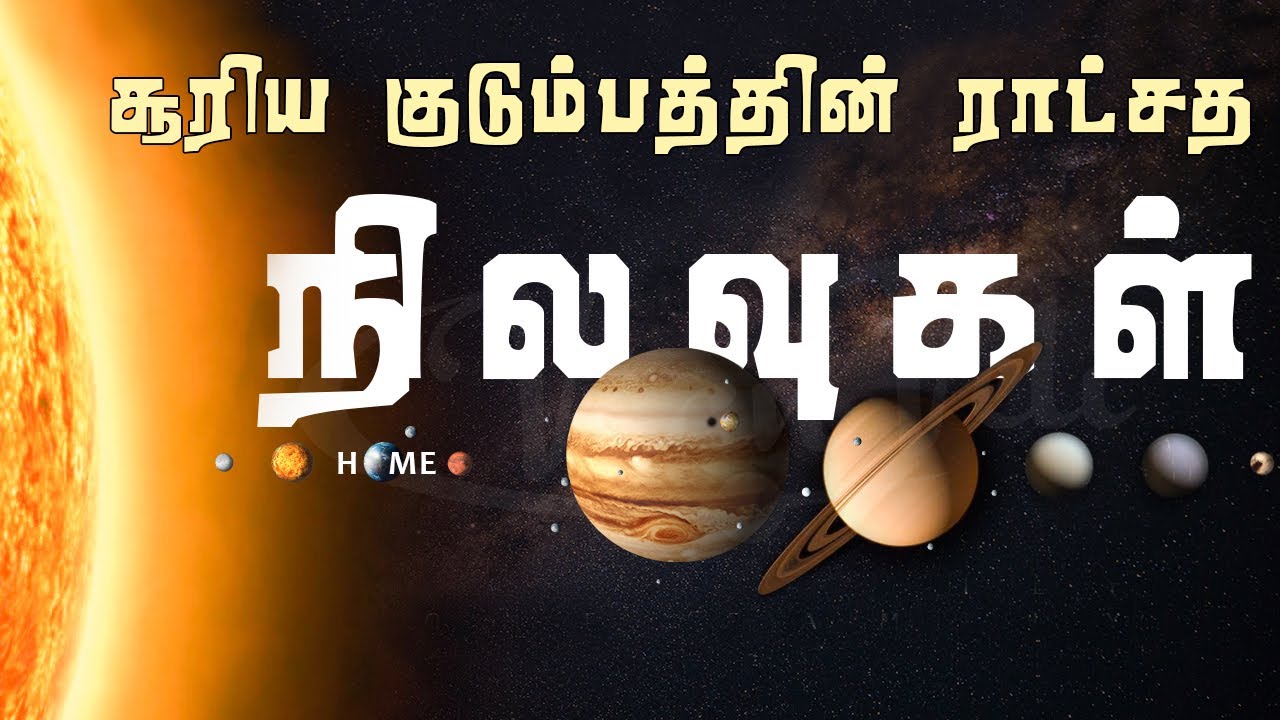
சூரிய குடும்பத்தின் விசித்திரமான 290 நிலவுகள். Solar System Moons
Each moons orbiting a different planet or dwarf planet.
The Moon (Luna) is the Earth's sole natural satellite. It is the Solar System's fifth-largest moon and has played an important part in Earth's history and civilization.
The Moons of Mars (Phobos and Deimos): Mars has two small moons, Phobos and Deimos. They have an irregular shape and are believed to be captured asteroids.
Jupiter has around 80 to 95 known moons, the four largest of which are known as the Galilean moons: Io, Europa, Ganymede, and Callisto. Galileo Galilei discovered them in 1610.
Saturn contains more than 146 known moons, including Titan, the second-largest moon in the Solar System with a thick atmosphere. Enceladus and Mimas are two other noteworthy Saturnian moons.
Moons of Uranus: Uranus has 27 recognised moons. Miranda, Ariel, Umbriel, Titania, and Oberon are notable examples.
Neptune's Moons: Neptune has 14 known moons, including Triton, the Solar System's seventh-largest moon. Triton is uncommon among big moons in that it orbits Neptune in reverse.
Pluto's Moon (Charon): Pluto is a dwarf planet with a very large moon named Charon. Charon, which is roughly half the size of Pluto, is tidally linked to it.
Moons of Dwarf Planets: Other dwarf planets in the Solar System, such as Eris and Haumea, have moons. Eris, for example, has one known moon named Dysnomia.
Some asteroids in the asteroid belt have minor moons or companions. The asteroid Ida, for example, has a moon called Dactyl.
TNOs are Trans-Neptunian Objects. Moons have been discovered around numerous TNOs, including Pluto, Eris, and Makemake.
Regards,
Vaan Veli
Santhosh
Follows on Facebook : https://www.facebook.com/vaanveli1
Follows on Instagram : https://www.instagram.com/vaan_veli
#vaanveli #vaanveli #solarsystemmoons #jupitermoons #saturnmoons #mercury #venus #earth #mars #jupiter #saturn #uranus #neptune #earth #moon #moons #iomoon #ganymede #sun #planetandmoon #earthmoon #chandrayaan3 #enceladusmoon #titanmoon #titaniamoon #pluto #moonfacts #moonhistory #solarsystemmoonsintamil #solarsystemmoonsandplanets #biggestmooninoursolarsystem #howmanymoonsareinoursolarsystem #solarsystem #mars #universe #callisto #space #venus #moonsize #solarsystem

In this video, we'll be discussing all the important Io Moon facts! From its name to its characteristics, this video is packed with information about the Io Moon.
If you're curious about the Io Moon, or want to know more about it, then this video is for you! We'll discuss everything you need to know about this fascinating moon, from its name to its characteristics. Be sure to watch until the end to learn about the amazing things that happen during the Io Moon!
IO Moon of Jupiter, IO Moon in tamil, IO Moon volcano eruption, IO Moon Surface, what is io mooon, IO moon temprature
Discovery: Io was discovered by Galileo Galilei on January 8, 1610, along with three other large moons of Jupiter.
Size: It is the fourth-largest moon of Jupiter and has a diameter of about 3,643 kilometers (2,263 miles).
Composition: Io is primarily composed of silicate rock and iron, similar to the terrestrial planets Mercury, Venus, Earth, and Mars.
Surface: Io has a diverse and geologically active surface, featuring numerous volcanic calderas, mountains, and plains.
Volcanic Activity: Io is the most volcanically active body in the solar system, with hundreds of active volcanoes spewing sulfur and other materials.
Lava Lakes: Some of Io's volcanic eruptions result in lava lakes, large molten pools of lava on its surface.
Ionian Name: Io is named after a priestess of Hera in Greek mythology who became one of Zeus's mortal lovers.
Orbit: Io orbits Jupiter at an average distance of about 422,000 kilometers (262,000 miles).
Orbital Period: It takes approximately 1.77 Earth days for Io to complete one orbit around Jupiter.
Tidal Heating: Io experiences intense tidal heating due to its elliptical orbit, caused by gravitational interactions with Jupiter and the other Galilean moons.
Surface Temperature: Io's surface temperatures can vary widely, with some regions reaching up to 1,600 degrees Celsius (2,900 degrees Fahrenheit).
Atmosphere: Io has a thin atmosphere composed mainly of sulfur dioxide, which freezes onto its surface when the moon is in shadow.
Surface Coloration: The surface of Io displays a variety of colors, including red, orange, yellow, and white, due to different types of materials and their oxidation states.
High Radiation Levels: Io is exposed to high levels of radiation from Jupiter's powerful magnetosphere, making it a challenging environment for spacecraft exploration.
Surface Changes: Observations over time have revealed significant changes in Io's surface features, indicating ongoing geological activity.
Peaks: Some of Io's mountains reach impressive heights, with several exceeding 10 kilometers (6 miles) in height.
Loki Patera: Loki Patera is a massive volcanic depression on Io, possibly a large lava lake or a complex system of interconnected lava lakes.
Surt Volcano: Surt is one of Io's prominent volcanoes, named after a fire giant in Norse mythology.
Prometheus: Prometheus is a large, elongated volcanic feature on Io with a distinctive shape, likely caused by repeated volcanic eruptions.
Voyager Missions: Io was first studied up close by NASA's Voyager 1 and Voyager 2 spacecraft in 1979.
Galileo Orbiter: The Galileo spacecraft, which orbited Jupiter from 1995 to
Regards,
Vaan Veli
Santhosh
Follows on Facebook : https://www.facebook.com/vaanveli1
Follows on Instagram : https://www.instagram.com/vaan_veli
Disclaimer:
This channel does not offer financial advice. All information on this channel is offered solely for educational and informational reasons. This channel does not guarantee that you will be able to generate money online using the method presented in the video. Your level of success in achieving the outcomes indicated in the video will involve hard work, aptitude, learning and experience. Before investing or joining any such site, this channel strongly suggested you to conduct thorough investigation.
#iomoonofjupiter #iomoonintamil #iomoonvolcanoeruption #iomoonsurface #whatisiomooon #iomoontemprature #iomoon #vaanveli #solarsystemmoons #solarsystem
