#moonhistory
Hi,
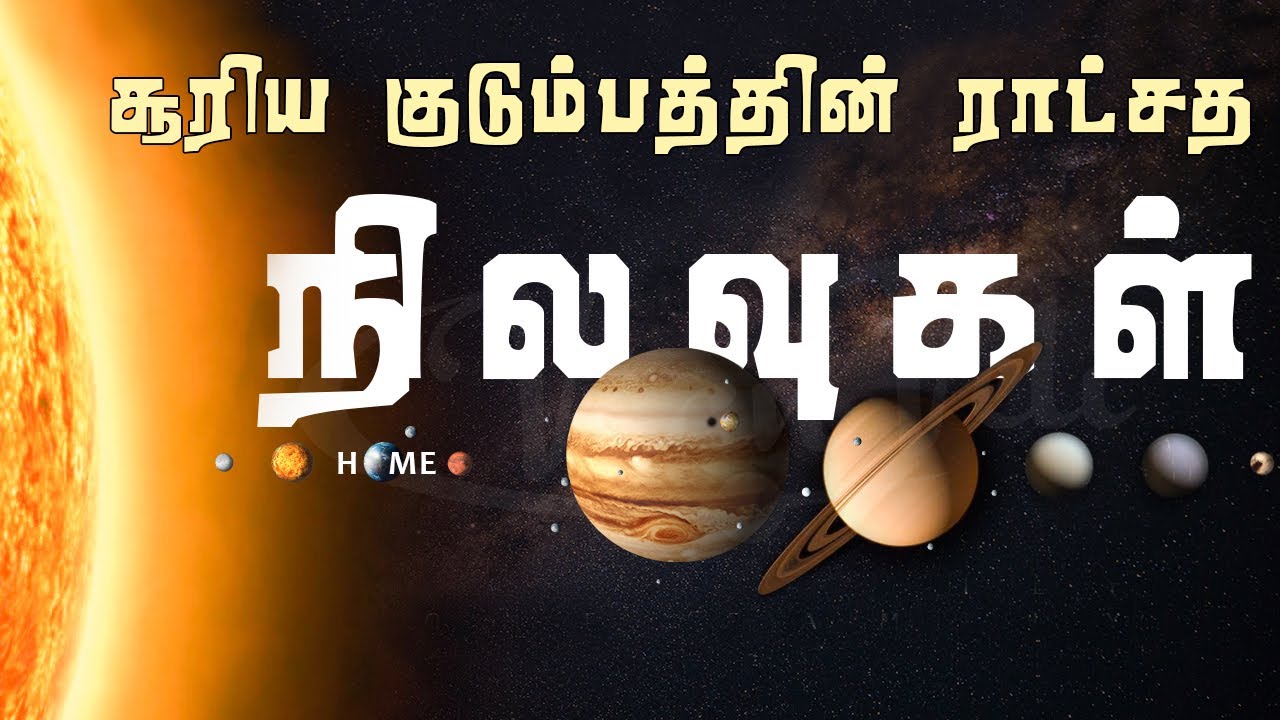
சூரிய குடும்பத்தின் விசித்திரமான 290 நிலவுகள். Solar System Moons
Each moons orbiting a different planet or dwarf planet.
The Moon (Luna) is the Earth's sole natural satellite. It is the Solar System's fifth-largest moon and has played an important part in Earth's history and civilization.
The Moons of Mars (Phobos and Deimos): Mars has two small moons, Phobos and Deimos. They have an irregular shape and are believed to be captured asteroids.
Jupiter has around 80 to 95 known moons, the four largest of which are known as the Galilean moons: Io, Europa, Ganymede, and Callisto. Galileo Galilei discovered them in 1610.
Saturn contains more than 146 known moons, including Titan, the second-largest moon in the Solar System with a thick atmosphere. Enceladus and Mimas are two other noteworthy Saturnian moons.
Moons of Uranus: Uranus has 27 recognised moons. Miranda, Ariel, Umbriel, Titania, and Oberon are notable examples.
Neptune's Moons: Neptune has 14 known moons, including Triton, the Solar System's seventh-largest moon. Triton is uncommon among big moons in that it orbits Neptune in reverse.
Pluto's Moon (Charon): Pluto is a dwarf planet with a very large moon named Charon. Charon, which is roughly half the size of Pluto, is tidally linked to it.
Moons of Dwarf Planets: Other dwarf planets in the Solar System, such as Eris and Haumea, have moons. Eris, for example, has one known moon named Dysnomia.
Some asteroids in the asteroid belt have minor moons or companions. The asteroid Ida, for example, has a moon called Dactyl.
TNOs are Trans-Neptunian Objects. Moons have been discovered around numerous TNOs, including Pluto, Eris, and Makemake.
Regards,
Vaan Veli
Santhosh
Follows on Facebook : https://www.facebook.com/vaanveli1
Follows on Instagram : https://www.instagram.com/vaan_veli
#vaanveli #vaanveli #solarsystemmoons #jupitermoons #saturnmoons #mercury #venus #earth #mars #jupiter #saturn #uranus #neptune #earth #moon #moons #iomoon #ganymede #sun #planetandmoon #earthmoon #chandrayaan3 #enceladusmoon #titanmoon #titaniamoon #pluto #moonfacts #moonhistory #solarsystemmoonsintamil #solarsystemmoonsandplanets #biggestmooninoursolarsystem #howmanymoonsareinoursolarsystem #solarsystem #mars #universe #callisto #space #venus #moonsize #solarsystem

#vaanveli #moonfacts #chandrayaan3
Hi,
இது தெரிஞ்சா நிலவுக்கு போகணும்னு நினைக்கமாட்டீங்க
15 Seconds Challenge on moon:
Because there is no oxygen, you would go unconscious in 15 seconds. Because there is little or no air pressure, your blood and bodily fluids would boil and then freeze.
1. The Moon is the sole natural satellite of Earth.
2. It is roughly one-sixth the size of Earth.
3. On average, the Moon is 238,855 miles (384,400 km) distant from Earth.
4. Because the Moon's gravity is about one-sixth that of Earth's, you would weigh less on the Moon.
5. The Moon possesses an exosphere, which is an extremely thin and tenuous atmosphere that contains trace amounts of helium, neon, and other elements.
6. The Moon orbits Earth in a roughly round orbit.
7. It takes the Moon approximately 27.3 Earth days to orbit our planet.
8. Because the Moon rotates once on its axis in around 27.3 days, we always view the same face from Earth, a phenomenon known as synchronous rotation.
9. The side of the Moon facing away from Earth is referred to as the "far side" or "dark side," despite the fact that it is not literally dark; it is simply obscured from our perspective.
10. The Moon's surface is covered in impact craters caused by billions of meteoroid collisions over billions of years.
The South Pole-Aitken Basin, which is about 1,550 miles (2,500 km) wide, is the Moon's largest crater.
12. Although there is no liquid water on the Moon's surface, there is evidence of water ice in permanently shadowed craters near the pole.
Temperature Extremes: The Moon experiences extreme temperature variations due to its lack of atmosphere. During its daytime, temperatures can reach over 100°C (212°F), while during its nighttime, temperatures can drop below -170°C (-274°F).
Moonquakes: The Moon experiences seismic activity, known as moonquakes. These can be caused by the gravitational interactions with Earth, the cooling and contraction of the Moon's interior, and the residual energy from ancient impacts.
Human Visits: The first human landing on the Moon was by NASA's Apollo 11 mission in 1969, when astronauts Neil Armstrong and Edwin "Buzz" Aldrin became the first humans to walk on the lunar surface.
Future Exploration: There are plans for future lunar exploration, including establishing a sustainable human presence on the Moon as a stepping stone for further space exploration, such as missions to Mars.
These are just a few intriguing facts about our Moon. It continues to be a subject of scientific research and inspiration for humanity's exploration of space.
Lunar Phases Influence Tides: The Moon's gravitational pull causes tides on Earth. When the Moon is at its closest point to Earth (perigee), tides can be especially high, known as spring tides. When the Moon is at its farthest point from Earth (apogee), tides are less extreme, known as neap tides.
Regards,
Vaan Veli
Santhosh
#vaan_veli #vaanveli #universe #solarsystem #earth #tamil #chandrayaan3update #moonfacts #moonfactsintamil #moon #moonhouse #homeonmoon #moondistance #earthvsmoon #nilavu #chandrayaan3 #chandrayaan3live #chandrayaan3tamil #livingonmoon #moonfactstamil #நிலவு #moonhistory #interestingfactsaboutmoon #luna #1lunarday #indianonmoon #chandrayaan3liveupdate #chandrayaan3todayupdate #chandrayaan3status #moonsouthpole #chandrayaan3
Follows on Facebook : https://www.facebook.com/vaanveli1
Follows on Instagram : https://www.instagram.com/vaan_veli

#vaanveli #moonfacts #chandrayaan3
Hi,
நிலவுக்கு குடி போகணும்னு ஆச படறீங்களா ? அப்போ நீங்க மட்டும் இத பாருங்க
what if we build a house in moon?
Buildings on the moon do not need to be as robust because gravity pull is around 6 times less. A ceiling/floor would require 6 times the mass to break than the comparable ceiling/floor on Earth.
Some moon Facts :
Natural Satellite: The Moon is Earth's only natural satellite and is about 1/6th the size of Earth.
Formation: The prevailing theory is that the Moon formed around 4.5 billion years ago when a Mars-sized object collided with a young Earth, and the debris from this collision eventually coalesced to form the Moon.
Phases: The Moon goes through different phases due to its position relative to the Sun and Earth. These phases include new moon, waxing crescent, first quarter, waxing gibbous, full moon, waning gibbous, third quarter, and waning crescent.
Synchronous Rotation: The Moon is in synchronous rotation with Earth, meaning it always shows the same face towards our planet. This side is often referred to as the "near side," while the other side is called the "far side" or "dark side."
Surface Features: The Moon's surface is covered in impact craters, large basins (such as the Imbrium, Serenitatis, and Crisium basins), mountains, valleys, and "seas" or dark, flat areas formed by ancient volcanic activity.
Gravity: The Moon's gravity is about 1/6th of Earth's gravity, which is why astronauts on the Moon can jump higher and objects are much lighter there.
Lunar Maria: The "seas" on the Moon are actually solidified basaltic lava flows from ancient volcanic activity. They were named "maria," which is Latin for "seas," by early astronomers who mistakenly thought they were bodies of water.
Lunar Phases Influence Tides: The Moon's gravitational pull causes tides on Earth. When the Moon is at its closest point to Earth (perigee), tides can be especially high, known as spring tides. When the Moon is at its farthest point from Earth (apogee), tides are less extreme, known as neap tides.
Temperature Extremes: The Moon experiences extreme temperature variations due to its lack of atmosphere. During its daytime, temperatures can reach over 100°C (212°F), while during its nighttime, temperatures can drop below -170°C (-274°F).
Moonquakes: The Moon experiences seismic activity, known as moonquakes. These can be caused by the gravitational interactions with Earth, the cooling and contraction of the Moon's interior, and the residual energy from ancient impacts.
Human Visits: The first human landing on the Moon was by NASA's Apollo 11 mission in 1969, when astronauts Neil Armstrong and Edwin "Buzz" Aldrin became the first humans to walk on the lunar surface.
Future Exploration: There are plans for future lunar exploration, including establishing a sustainable human presence on the Moon as a stepping stone for further space exploration, such as missions to Mars.
These are just a few intriguing facts about our Moon. It continues to be a subject of scientific research and inspiration for humanity's exploration of space.
Regards,
Vaan Veli
Santhosh
Follows on Facebook : https://www.facebook.com/vaanveli1
Follows on Instagram : https://www.instagram.com/vaan_veli
#vaan_veli #vaanveli #universe #solarsystem #earth #tamil #chandrayaan3update #moonfacts #moonfactsintamil #moon #moonhouse #homeonmoon #moondistance #earthvsmoon #nilavu #chandrayaan3 #chandrayaan3live #chandrayaan3tamil #livingonmoon #நிலவுக்குகுடிபோகணும்னுஆசபடறீங்களா #நிலவு #moonhistory #interestingfactsaboutmoon #luna #1lunarday #indianonmoon #chandrayaan3liveupdate #chandrayaan3todayupdate #chandrayaan3status #moonsouthpole #chandrayaan3

What if the moon disappeared? Would we know what was going on in the world? In this video, we'll explore this question and more.
We'll look at the history of the moon, how it's related to our planet, and how it might be disappearing. We'll also share some theories on what might happen if the moon disappeared. Finally, we'll ask the question: If the moon disappeared, what would happen to our planet? Go ahead and check out the video to find out!
Regards,
Vaan Veli
நிலவு இல்லாத பூமி என்ன ஆகும் தெரியுமா ?
#whatifmoondisappeared #whatif #earth #moon #whatifthemoondisappeared #whatifmoondisappears #earthandmoon #moonfacts #moonfactsintamil #whatifmoondisappearintamil #moontamil #nilavu #moonhistory #historyofthemoon #moonage #moonbrightness #moondistancefromearth #earthvsmoon #space #science #solarsystem #mars #darksideofthemoon #themoon #theuniverse #earthandmoon #whatiftherewasnomoon #moondisappeared #vaanveli #vaanveli #tamil #nila
