#vaanveli

Vaan Veli
2 Views · 5 months ago

In this video we’re going to see about one of the largest planets in the solar system, The Jupiter (King of the Planet).

Jupiter

Jupiter is fifth planet from the Sun and the largest in the Solar System, the most seasoned and most monstrous world in the nearby solar system. Find out about the planet's history, its Extraordinary Red Spot and maritime moons, and what this antiquated world meant for the development of the solar system's different planets.

The Jupiter ring is divided into three parts. The deepest part is called hello. The middle of the ring is the brightest part. The outermost part of a ring is called a gossamer ring. This ring extends up to 225,000 kilometers from the planet and is 2,000-12.500 kilometers thick.

King of Solar System

The King of the planet, Jupiter, a colossal world that scientists believe can help us better understand the origin of the solar system.

Nine automated rocket have visited the gas planet up until this point, two of which entered into outer space (orbit), permitting us to concentrate on its perplexing, emotional environment more than ever.

The mystery of Jupiter

Yet, Jupiter, actually holds numerous secrets, for example, what lies underneath its strange mists and to jump considerably more profound, what is at its center? Go on an outing within the nearby planet groups biggest planet and figure out researchers' thought process is happening down there, it's very bizarre.


Jupiter is the largest planet in our solar system and one of the most interesting. In this video, we'll explore what Jupiter is, what the Jupiter Red Spot is, and how to learn more about it.

Jupiter is a big planet and you can learn a lot about it by reading articles and watching videos. In this video, we'll provide a basic overview of Jupiter and its many strange and interesting features. Be sure to check out the Jupiter Red Spot for yourself and see for yourself just how amazing this planet is!

Regadrs,
Vaan Veli.


#jupiter #jupiterascending #jupitermoon #lifeonjupiter #nasa #viyalankiragam #jupiterintamil #jupiterfactsintamil #aboutjupiter #jupiterfacts #solarsystem #planetjupiter #biggestplanet #space #cosmology #jupitertamil #whatif #tamil #planets #spacescience #jupiterplanet #planetjupiter #intamil #jupiterplanetexplained #explainjupiter #jupitermass #earthvsjupiter #jupiterstar #iomoon #howmanymoonsinjupiter #europa #ganymede ede #callisto #vaanveli #gk

Vaan Veli
2 Views · 5 months ago

This video is going to share you about the total Lunar Eclipse will going to take place on November 8, 2022.

What is Total Lunar Eclipse

Total Lunar eclipse is the event occur when Earth's shadow is cast across the entire lunar surface.
Try binoculars or a telescope for a better view. or USE DSLR with Tele Lense or USE DSLR with Tele Lense
How Total Lunar Eclipse Occur

Lunar Eclipse happen when Earth is situated between the sun and the moon, creating a shaded area across the surface of the moon.

Total Lunar Eclipse November-2022

This lunar eclipse is the final total lunar eclipse of the year 2022, during a total lunar eclipse, the moon will appears to turn blood red while passing through Earth's shadow and it will be visible in parts of Asia, Australia, North America, parts of northern and eastern Europe, and most of South America.

Lunar Eclipse Time in India
[India: 5.32PM to 6.18 PM]

[ Total time : 2:27 PM - 5:55 PM ]

Travel Time :
2:27 : The Moon enters Earth’s umbra, and the partial eclipse begins.
3:29 : The entire Moon is now in the Earth’s umbra, and the Moon will turn a coppery red. Try binoculars or a telescope for a better view. or USE DSLR with Tele Lense
4:53 : As the Moon exits Earth’s umbra, the red colour fades, and it looks like a bite is taken from the opposite side of the lunar disk.
5:55 : The whole Moon is in Earth’s penumbra, but the dimming is subtle again.


Regards,
Vaan Veli
வாழ்க தமிழ்


#eclipse #chandragrahan2022 #grahan #lunareclipse #lunareclipsenovember2022 #chandragrahan2022inindiadateandtime #chandragrahan #lunareclipse #fullmoon #moon #lunareclipse2022 #eclipselunar2022 #fullmoonlunareclipse #superlunareclipse #totallunareclipse2022 #bloodmoonlunareclipse #fulllunareclipse #சந்திரகிரகணம் #chandragrahantamil #bloodmoon #lunar #redmoon #whatisabloodmoon #whatislunareclipse #lunareclipsevideos #vaanveli #tamil #whatif #gk #chandragrahantime #chandragahanam #chandragraganam #chandrakiraganam #chandragrahanam #chandragrahantime #chandragrahanintamilnadu
#redmoon #bloodmoon #சந்திரகிரகணம்2022 #சந்திரகிரகணம்nov82022 #chanthiragraganam #lunareclipse2022

Vaan Veli
2 Views · 5 months ago

பிரபஞ்சத்தின் ஆபத்தான கிரகங்கள் [ Top Dangerous Planets in the Universe ]

In this video, we're going to be talking about some of the most dangerous planets in the universe!

From Venus to Neptune, these planets are full of dangerous elements and hazards that could potentially kill you if you were to visit them. So if you're thinking of traveling to any of these planets, be sure to research them first!

By the end of this video, you'll know everything you need to know about the dangerous planets in the universe!

Regards,
Vaan Veli


#nasa #facts #space #whatif #jupiter #earth #universe #solarsystem #cosmos #stars #planets #planets #exoplanet #dangerousplanetsdocumentary #venus #corot-7b #gliese436b #planetjensen #gianthd1897 #hd80606b #kelt9b #kepler78b #wasp12b #terribleplanets #topplanetslikeearth #earth2 #dangerousplanets #topplanets #planetlikeearthdiscovered #planetsfacts #gk #planetscience #nasadartmission #nasadart #planetstamil #vaanveli #tamil #scienetamil #blackhole

Vaan Veli
2 Views · 5 months ago

Truth Behind Animals Sent To Space,
Laika was a normal street dog in Russian country, The aim was to find out how long a dog can survive in space. On 3 November 1957 russians launched Laika into space inside a spacecraft named Sputnik-2. It was a one way ticket for laika because there was no way to bring her back to Earth. Space has no boundaries. You must admit that there is something incredibly attractive and mysterious in this dark surrounding our earth, Some of these interesting facts are amazing yet terrifying at the same time. i am really feld bad about the innocent animals that really what happend to them in the history.

Regards,
VaanVeli


#mystery #blackhole #minutesmystery #spacemysteries #spacemysteryintamil #spacemysteriousfacts #spacesnakeintamil #spacedeadbodies #spacedeadbody #விண்வெளியில்சடலங்கள் #spacesnake #nasa #ufo361 #space #aliens #alien #tamil #vaanveli #alientamil #spacenewstamil #spacefactsintamil #spacefacts #animalsinspace #laikaspacedog #doginspace #scaryspacephoto #alienship #moon #moontravel #neilarmstrong #truthbehindanimalssenttospace #gk #whatif #earth #laika #dog #dogs #snake #snakes #snakevideo #space #earth #moon #tamil #milkyway #sciencetamil #astronaut #spaceship #spacex #spacedog #spacesnake #top10 #spacenews #newstamil #tamilnews

Vaan Veli
2 Views · 5 months ago

Hi everyone,
We think we know everything about our home planet, but we couldn’t be more wrong. Scientists have already discovered a lot about the Universe, but they believe there is still much more to learn about our planet. You’ll be amazed when you find out how much you have yet to learn about our home planet, let’s start with 45 unknown earth facts.

Summary:
1. There weren't always several continents
2. Some 300 million years ago, there was just one continent. A massive
supercontinent called Pangaea. And thus, there was just one giant sea,
called Panthalassa.
3. Our solar system is 4.57 billion years old.
4. Researches calculate that the earth is approximately 4.54 billion years old,
that is insanely old.
5. The earth is approximately 93 million miles (150million kilometres) from
the Sun. It makes about 8 minutes and 19 seconds for sunlight to reach our
planet.
6. Earth's gravity isn't uniform
7. Because of imbalance gravity/centrifugal force at the equator coupled with
the speed that the earth is spinning. Our planet is not a perfect sphere. it is
slightly bulging out in the middle.

9. Our poles switch. our planet has settled into a pattern of a pole reversal
about every 2,00,000 to 3,00,000 years.
10.The circumference of the globe is 24,901 miles (40,075 kilometres)
11.The earth isn't just spinning in place, its zipping around the sun at a rate of
67,000miles (107.826 kilometres) per hour.
12. Earth's icy times
13. In the past, sea levels were very different
14.The days are getting longer.
15.At the equator, you would weigh less than if standing at one of the poles.
16.Depending on where you are on the globe, you could be spinning through
the space at just over 1,000 miles per hour.
17.Hudson Bay, Canada, has lower gravity than other regions of the earth.
18.The Pacific Ocean is huge; it covers an area of about 59 million square
miles (155 million square kilometres) and containing more than the half of
the free water on earth.
21.Coral reefs support the most species per unit. Area of any of the planet's
ecosystems, rivalling rain forests.
22.Researchers believe that at one point, we had two moons. our second moon would have been about 750 miles orbited the earth in the past.
23.We always see the same side of the Moon, no matter where we stand on Earth.
24.The moon is not Earth's only companion
25.The lowest point on earth that is ' on land' is the dead sea
26.The driest place on Earth
27.El Aziziya, Libya holds the record for the hottest place on earth. According
to NASA, it hit 136 degrees Fahrenheit (57.8 degrees Celsius) on
September 13, 1922.
28.The lowest temperature ever recorded on earth came from Russia's Vostok station
29.The calm before the storm
30.A single stroke of lightning can heat the air to around 54,000 degrees
31.Our sun has a voracious appetite
32.Only 5% of the universe is visible from Earth.
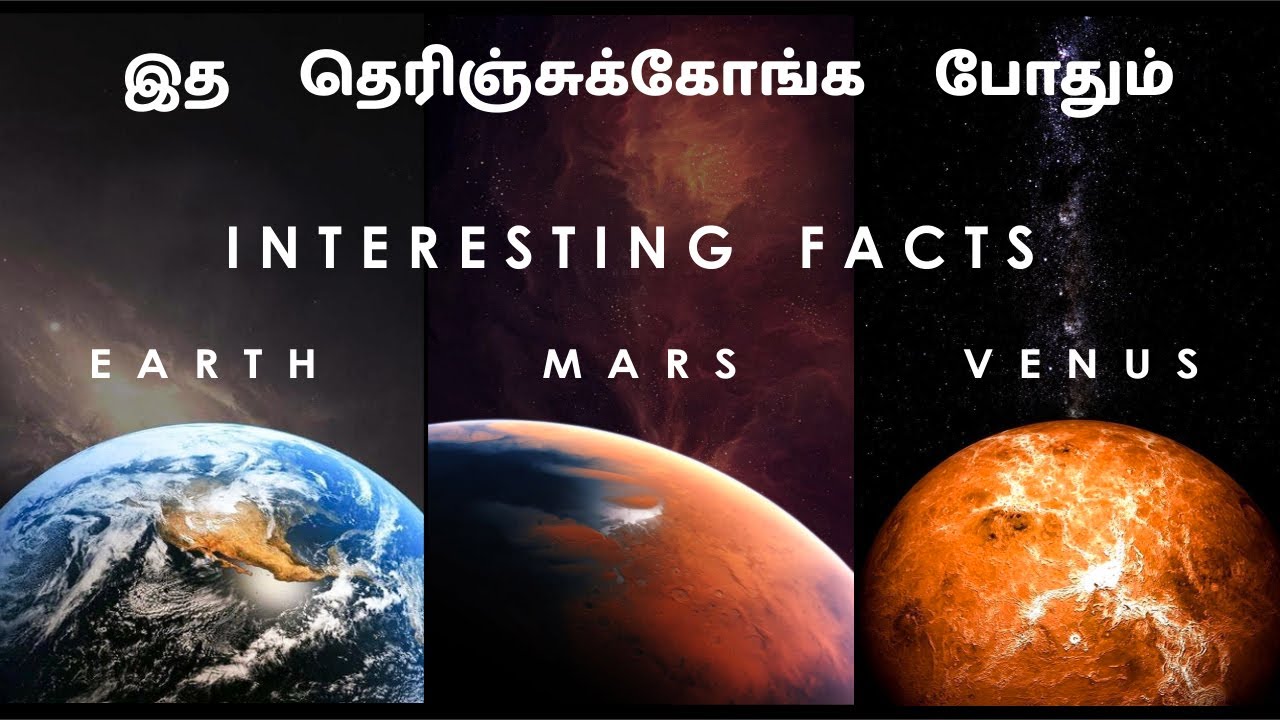
33.Earth is one of the four terrestrial planets: like Mercury, Venus, and Mars. It is rocky at the surface.
34.In our solar system that are 4 planets known as gas giants: Jupiter, Saturn, Uranus & Neptune.
35. Mercury & Venus are the only 2 planets in our solar system that have no moons.
37.The hottest planet in the solar system is Venus with an average temperature
of 464 degree Celsius
38. The coldest planet in the solar system is Pluto with an average
temperature of -225 degree Celsius.
39.The Sun weighs about 330,000 times more than Earth.
41.Pluto is smaller than the United States

#top10 #facts #amazing #interestingfacts #coolfacts #amazingfacts #interestingfactsabouttheworld #solarsystem #earth #moon #sun #factsaboutspace #factsintamil #factsthatwillshockyou #brightsidevideos #factsaboutearth #factsaboutworld #factsabouttheearth #twomoons #interestingvideos #mysteriousworld #rarefacts #factsyoumustknow #shockingfacts #factsaboutsolarsystem #scientificfacts #brightside #mars #vaanveli #tamil #mysterybrightside #brightsidefacts

Vaan Veli
2 Views · 5 months ago

The Solar System in 3D Visualization: The Solar System is the gravitationally bound system of the Sun and the objects that orbit it. It formed 4.6 billion years ago from the gravitational collapse of a giant interstellar molecular cloud. please check our video and give us your valuable feedback to improve the quality thanks.

Regards,
Vaan veli


#solarsystem #the8planetsinoursolarsystemfacts #neptuneorbit #planetx #moon #sunset #neptune #earth2 #pluto #mercury #saturn #blackhole #mars #milkywaygalaxy #sizecomparison #solarsystemfacts #solarsystemdocumentary #planetsizecomparison #factsaboutspaceandtheuniverse #planetsizescomparisonvideo #solarsystem3d #venus #jupiter #planets #uranus #solar #3dsolarsystem #earthsize #earthtilt #solarplanettilt #saturnrings #planetsin3d #vaanveli #universe #starwars #gk

Vaan Veli
2 Views · 5 months ago

1000 வருடத்திற்கு மேல் பூமியில் சூரிய ஒளி இல்லாமல் போனால் என்ன நடக்கும் தெரியுமா ? பூமியில் பெரிய எரி கல்லோ அல்லது பெரிய எரிமலையோ வெடித்தால் என்ன நடக்கும் என்பதை காட்டி உள்ளோம், அனைவரும் பார்த்து தங்களின் கருதுக்களை தெரிவிக்கலாம் நன்றி .

What If There was No Sunlight to Earth?

If there was no sunlight reaching Earth, the consequences would be catastrophic for life as we know it. Sunlight is essential for numerous biological and physical processes on our planet. Here are some of the major impacts:

Loss of Photosynthesis: Sunlight is crucial for photosynthesis, the process by which plants and some bacteria convert light energy into chemical energy to produce food. Without sunlight, photosynthetic organisms would be unable to survive, leading to the collapse of the entire food chain.

Ecosystem Disruption: The extinction of plants would result in the extinction of herbivores that rely on them for sustenance. This, in turn, would affect carnivores and other predators in the ecosystem. The disruption would likely cause a mass extinction event.

Temperature Drop: The Sun's energy is responsible for heating the Earth's surface. Without sunlight, the planet would rapidly cool down. The temperature drop would be drastic, leading to extremely cold conditions, especially in areas away from geothermal heat sources.

Loss of Atmospheric Circulation: Sunlight plays a crucial role in driving atmospheric circulation, which includes the formation of weather patterns and wind currents. Without sunlight, the atmosphere would become stagnant, resulting in the loss of weather systems and wind patterns.

Darkness: Obviously, the absence of sunlight would plunge Earth into darkness. The sky would be devoid of the typical blue color, and daylight-dependent activities would become impossible.

Disruption of the Water Cycle: Sunlight provides the energy required for the evaporation of water, which is an essential component of the water cycle. Without sunlight, the water cycle would slow down significantly, affecting rainfall patterns, freshwater availability, and overall climate stability.

Impact on Human Life: Humans, along with other organisms, depend on sunlight for vitamin D synthesis, which is crucial for bone health. The absence of sunlight would lead to widespread vitamin D deficiencies, resulting in health issues. Additionally, agriculture, which heavily relies on sunlight, would be severely affected, leading to food shortages and famine.

Regards,
VaanVeli


#volcano
#earthquake #earth #planets #extinction #clouds #பூமி #volcano #earthquake #planets #extinction #clouds #universe #galaxy #cloud #disaster #vaanveli #animals #explosion #earthattack #climatecrisis #climate #globalwarming #savetheworld #science #dangeredspecies #savetheplanet #sustainability #dinosaurs #environment #extinction #dinosaur #climatechange #wildlife #nature #extinction #supervolvano #yellowstone #asteroid #whatif #earth #whathappensif #nasa #top5 #space #universe #solarsystem #tamil #extinciondinosaurios #shorts

Vaan Veli
1 Views · 5 months ago

டயனோசர்களின் தோற்றமும் மறைவும் | Evolution of dinosaurs #dinosaur #vaanveli #extinction

Origins and Early Evolution
Triassic Period (approximately 250-201 million years ago):
Archosaurs: Dinosaurs evolved from a group of reptiles called archosaurs. Early archosaurs appeared in the Triassic period, and from them, the first dinosaurs emerged.
Eoraptor and Herrerasaurus: Among the earliest known dinosaurs are Eoraptor and Herrerasaurus, small bipedal predators from South America, dating back to around 231 million years ago.
Major Dinosaur Clades
Jurassic Period (approximately 201-145 million years ago):

Saurischia: This group includes theropods (bipedal carnivores like Tyrannosaurus rex) and sauropodomorphs (long-necked herbivores like Brachiosaurus).
Ornithischia: This diverse group of herbivorous dinosaurs includes stegosaurs (Stegosaurus), ankylosaurs (Ankylosaurus), and hadrosaurs (duck-billed dinosaurs).
Cretaceous Period (approximately 145-66 million years ago):

Diversification: Dinosaurs reached their peak diversity during the Cretaceous. Major groups like ceratopsians (Triceratops) and theropods, which later gave rise to birds, flourished.
Bird Evolution: Theropod dinosaurs, particularly a group called maniraptorans, evolved into birds. The famous Archaeopteryx is often cited as a transitional fossil between non-avian dinosaurs and birds.
Extinction and Legacy
Cretaceous-Paleogene (K-Pg) Extinction Event (approximately 66 million years ago):
Mass Extinction: A catastrophic event, likely an asteroid impact, led to the extinction of most dinosaur species. However, avian dinosaurs (birds) survived and are their direct descendants.

Climate Change: The impact and subsequent environmental changes caused by the impact led to a drastic cooling of the Earth's climate. This would have disrupted ecosystems, causing a decline in plant life, which, in turn, would have affected herbivorous dinosaurs and the predators that relied on them.

Mass Extinction: The combination of factors, including extreme temperature fluctuations, lack of sunlight, and ecological disruption, likely resulted in a mass extinction event. Many species, including the non-avian dinosaurs, went extinct during this time.

Surviving Species: While the non-avian dinosaurs went extinct, some groups of animals, such as birds, small mammals, and reptiles, managed to survive and eventually evolve into the diverse life forms we see today. Birds are the only living descendants of the dinosaur lineage.

Adaptive Radiation: Dinosaurs adapted to various ecological niches, leading to a wide range of forms and sizes, from tiny, feathered theropods to enormous sauropods.
Feathers and Flight: Many theropods had feathers, initially for insulation or display, which eventually evolved for flight in the ancestors of birds.
Social Behavior: Evidence of social behavior, such as nesting sites and herd movement, suggests complex behaviors among some dinosaur species.


Regards,
Vaan Veli
Santhosh


Follows on Facebook : https://www.facebook.com/vaanveli1
Follows on Instagram : https://www.instagram.com/vaan_veli

#evolutionofdinosaurs #dinosaureolution #volcano
#vaanveli #universe #solarsystem #earth #tamil #dinosaur #dinosaurs #dinasourimpact #asteroidimpact #chicxulubcrater #chicxulub #asteroid #dinosaursextinction #dinosaursintamil #dinosaurmovie #dinosaurvideo #dinosaurfootage #realdinosaur #lastmomentofdinosaurs #6thextinction #cretaceous #5massextinctions #largestcreatureintheworld #snake #crocodile #animals #birds #shark #66millionyearsago #6.6croreyearsago #dinosaurlivingperiod #humanevolution #gk

Vaan Veli
1 Views · 5 months ago

Hi,
பிரமீடை காட்டியது ஏலியனா இல்ல மனிதனா ? The Pyramid vs Aliens
Pyramid Shape: The most distinctive feature of pyramid architecture is the use of a pyramid shape or form in the design of buildings or structures. This shape is characterized by a polygonal base and triangular sides that slope upward to a single point or apex.

Historical Inspiration: Pyramid architecture often draws inspiration from the ancient pyramids of Egypt, particularly the Great Pyramid of Giza. These ancient structures were built as tombs for pharaohs and have a well-known stepped-pyramid design.

Symbolism: Pyramids have symbolic significance in various cultures. In addition to their historical use as tombs, they can represent concepts such as stability, endurance, and ascension.

Modern Interpretations: While ancient pyramids were constructed using massive stone blocks, modern pyramid architecture may use a wide range of materials, including glass, steel, concrete, and more. Architects and designers may incorporate pyramid-like shapes or elements into contemporary buildings for aesthetic or symbolic purposes.

Pyramid Roof: Some buildings have pyramid-shaped roofs or spires, which can give them a distinct appearance. These roofs can be found in a variety of architectural styles, from ancient to modern.

Functionality: Pyramid architecture can be applied to various types of buildings, not just tombs. Modern architects may use pyramid designs for residential homes, commercial buildings, museums, and other structures.

Cultural Variations: Different cultures have their interpretations of pyramid architecture. For example, Mesoamerican civilizations like the Maya and Aztec built pyramidal temples. These structures often have stepped pyramid designs and serve religious or ceremonial purposes.

Sustainability: Pyramid architecture can also be associated with sustainable design principles. The shape of a pyramid can be efficient for natural ventilation and energy conservation, making it a consideration in green building practices.


Regards,
Vaan Veli
Santhosh


Follows on Facebook : https://www.facebook.com/vaanveli1
Follows on Instagram : https://www.instagram.com/vaan_veli


#vaanveli #vaanveli #universe #solarsystem #earth #tamil #pyramid #pyramidvsalien #pyramidfacts #pyramidhistory #pyramidarchitecture #whocreatedpyramidsofegypt #pyramidhight #giza #gizapyramid #pyramidintamil #pyramidvideo #pyramidhistoryintamil #pyramidsize #pyramidvsburjkhalifa #largestpyramid #tallestpyramidintheworld #pyramidtamil #whomadepyramidsinegypt #alien #pyramidmummy #mummyintamil #mummytamil #pyramidegypt #pyramidscience

Vaan Veli
1 Views · 5 months ago

Luna 25 crashed what really happened, Details in the video. The robotic Luna-25 spacecraft appeared to have “ceased its existence” after a failed orbital adjustment, the space agency Roscosmos said, Russia's first moon mission in 47 years failed after its Luna-25 spacecraft spun out of control and smashed into moon on August 20. Russia's state space corporation, Roskosmos, said it had lost contact with the craft shortly after a problem occurred as the craft was shunted into pre-landing orbit today.
Russia’s first moon mission in decades fails as Luna-25 crashes into lunar surface; all eyes on Chandrayaan-3 now
ussia’s Luna-25 has crashed on the Moon’s surface, the country’s space agency said Sunday, leaving India’s Chandrayaan-3 on course to become the first spacecraft to land near the lunar south pole.

On Sunday morning, Chandrayaan-3 moved into its pre-landing orbit of 25 km x 134 km from the lunar surface, in preparation for its scheduled landing on Wednesday. It is from this orbit that the spacecraft would begin its descent at around 5.45 pm IST on Wednesday. The touchdown is expected to happen after 15 minutes.

Luna-25 was scheduled to make a soft landing on the Moon’s surface on Monday, August 21, two days ahead of Chandrayaan-3. Both of them were supposed to land in the region around the lunar south pole. But the Russian spacecraft developed problems on Saturday as it tried to move into the pre-landing orbit

Regards,
Vaan Veli
Santhosh

Follows on Facebook : https://www.facebook.com/vaanveli1
Follows on Instagram : https://www.instagram.com/vaan_veli

#lunacrash #lunacrashexplained #lunacrashed #lunacrash #lunacrashlive #lunacrashedvideo #lunacrashedonmoon #whylunacrashed #luna25 #luna25crash #chandrayaan3 #chandrayaan3live #chandrayaan3update #isrochandrayaan3 #isro #luna25launch #luna25update #lunecrashintamil #luna25crashintamil #lunewhycrash #luna25hit #lune25collide #luna25collideonmoon #luna25vschandrayaan3live #chandrayaan3currentlocation #vaanveli #luna

Vaan Veli
1 Views · 5 months ago

சந்திரயான் 3 சந்திக்கப்போகும் மிக பெரிய சவால் | மிக முக்கியமான கட்டம் இன்று

Chandrayaan-3:
Chandrayaan-3 is the third lunar exploration mission by the Indian Space Research Organisation (ISRO). It is a follow-up to Chandrayaan-2, which consisted of an orbiter, lander (Vikram), and rover (Pragyan). However, the Vikram lander failed to make a soft landing on the Moon's surface. Chandrayaan-3 is intended to rectify this by focusing solely on the lander and rover components, aiming to achieve a successful landing.


Regards,
VaanVeli


#chandrayaan3 #chandrayaan #chandrayaan3update #chandrayaan3status #chandrayaan3live #chandrayaan3liveupdate #chandrayaan3currentupdate #chandrayaan3tamil #chandrayaan3intamil #சந்திரயான்3 #சந்திரயான் #chandrayaan3vsluna25 #chandrayaanvsluna #moon #moonmission #chandrayaan3mission #chandrayaan3livestatus #chandrayaan3today #chandrayaan3news #chandrayaan3todaynews #chandrayaan3video #chandrayaan3rover #chandrayaan3lander #vaanveli #gk #chandrayaan3livelocation #chandrayaan3mission #chandrayaan3landing #chandrayaan3landingtime
#chandrayaannews #லூனா #luna25 #luna25vschandrayaan3 #lunar #luna25mission #lunacurrentlocation

Vaan Veli
1 Views · 5 months ago

Hi All,

The Chicxulub asteroid is a term commonly used to refer to the massive asteroid or comet impact that occurred approximately 66 million years ago. This impact is believed to be the primary cause of the Cretaceous-Paleogene (K-Pg) extinction event, which resulted in the extinction of about 75% of plant and animal species on Earth, including the dinosaurs.

The impact site is located near the town of Chicxulub in Mexico's Yucatan Peninsula. The asteroid or comet that struck Earth was estimated to be about 6 miles (10 kilometers) in diameter. The impact released an enormous amount of energy, equivalent to billions of atomic bombs, causing widespread devastation.

The impact triggered a chain of catastrophic events, including massive earthquakes, tsunamis, and wildfires. It also released an enormous amount of dust, soot, and vaporized rock into the atmosphere, blocking sunlight and causing a global cooling effect. The reduced sunlight led to a significant decrease in photosynthesis, disrupting the food chain and causing the extinction of many plant and animal species.

The Chicxulub impact left a distinct crater, which was discovered in the early 1990s through geological surveys and subsequent drilling. The crater measures approximately 93 miles (150 kilometers) in diameter and is buried beneath layers of sediment.

The study of the Chicxulub impact has provided valuable insights into the dynamics of large asteroid or comet impacts and their potential effects on Earth's ecosystems. It has also contributed to our understanding of the history of life on Earth and the mechanisms of mass extinctions.

The Chicxulub impactor, also known as the Chicxulub asteroid or the K-Pg asteroid, refers to a massive asteroid or comet that is believed to have struck the Earth approximately 66 million years ago. The impact of this asteroid is considered to be a significant event in Earth's history as it is widely associated with the mass extinction event that led to the demise of the dinosaurs and many other species.

Here are some key details about the Chicxulub impactor:

Size and Impact: The Chicxulub impactor is estimated to have been about 6 to 9 miles (10 to 15 kilometers) in diameter. When it struck the Earth, it unleashed an immense amount of energy, equivalent to billions of nuclear bombs.

Location: The impact site is located near the town of Chicxulub in the Yucatan Peninsula of modern-day Mexico. The region is known for a prominent crater, known as the Chicxulub crater, which was discovered in the early 1990s.

Extinction Event: The impact of the Chicxulub asteroid is widely believed to have caused or significantly contributed to the Cretaceous-Paleogene (K-Pg) mass extinction event. This event led to the extinction of approximately 75% of all species on Earth, including non-avian dinosaurs.

Environmental Effects: The impact generated a massive amount of heat, causing widespread wildfires and releasing enormous quantities of dust, ash, and gases into the atmosphere. This resulted in a global climate change event, with a significant drop in temperature and a reduction in sunlight reaching the Earth's surface. These changes severely disrupted ecosystems and led to the extinction of many plant and animal species.

Crater Formation: The impact created a crater that is approximately 93 miles (150 kilometers) in diameter and 12 miles (20 kilometers) in depth. Over time, geological processes and erosion have modified the original structure, but the remnants of the crater are still visible.

Discovery and Confirmation: The presence of a large impact crater in the Yucatan Peninsula was first proposed in the late 1970s. In the early 1990s, scientific drilling in the region provided evidence supporting the hypothesis that the Chicxulub impactor was responsible for the K-Pg mass extinction event.


Regards,
VaanVeli


#asteroid #chicxulubcrater #earth #chicxulub #chicxulubasteroid #chicxulubintamil #chicxulubasteroidintamil #vaanveli #tamil #whatif #asteroidcomparison #asteroidsize #asteroidintamil #craterintamil #dinosaur #dinosaurs #shorts #dinosaurus #dinosaurvideos #dinosaurvideojurassic #dinosaurextinction #chicxulubimpact #impact #thechicxulubimpactor #science #extinction #asteroidimpact #dinosaursintamil #chicxulubimpactsimulation #asteroidhitearth #solarsystem #asteroidbelt #gk #animals #dino

Vaan Veli
1 Views · 5 months ago

எரிமலை என்றால் என்ன? எரிமலை எப்படி உருவாகின்றது, எரிமலையின் ஆபத்துகளும், நன்மைகளும் தெரிந்துகொள்ளுங்கள் .

A volcano is a crack in the crust of a planet, such as Earth, that allows hot lava, volcanic ash, and gases to escape from a magma chamber beneath the surface. Volcanoes are most commonly found where tectonic plates are diverging or converging on Earth, and the majority are found underwater.

A volcano is a hole in the crust of a planet or moon through which molten rock, hot gases, and other materials erupt. As layers of rock and ash build up from repeated eruptions, volcanoes often form a hill or mountain. Volcanoes can be active, dormant, or extinct.

நன்றி
வாழ்க தமிழ்
Vaan Veli


#volcano #eruption #volcanoeruption #volcanointamil #volcaniceruptions #krakatoaeruptionintamil #volcaniceruptionintamil #icelandvolcano #எரிமலைவகைகள் #volcanovideo #volcanoeskrakatoalava #magma #supervolcanos #volcanoisland #top10deadliestvolcanos #deadliestvolcanoeruptions #worstvolcanoeruption #hawaii #lavaflows #pompeii #biggestvolcanos #yellowstonevolcano #tamboraeruption #krakatoasize #krakatoa #krakatoatamil #crustmantlecoreearthcore #எரிமலை #volcanodocumentary #vaanveli #typesofvolcano #krakatoaeruptiontamil


Showing 4 out of 4