#facts

Hi,
Star Classification: The Sun is a G-type main-sequence star, often referred to as a G-dwarf star or a yellow dwarf.
Size and Mass: The Sun is about 109 times the diameter of Earth and approximately 333,000 times its mass. It accounts for about 99.86% of the total mass of the entire Solar System.
Energy Source: The Sun's energy comes from nuclear fusion reactions occurring in its core, where hydrogen nuclei fuse to form helium, releasing a tremendous amount of energy in the process.
Light Travel Time: The sunlight we see from the Sun actually left its surface about 8 minutes and 20 seconds ago. This is because light takes time to travel the distance between the Sun and Earth.
Surface Temperature: The Sun's surface, known as the photosphere, has an average temperature of around 5,500 degrees Celsius (9,932 degrees Fahrenheit). However, the Sun's core temperature reaches millions of degrees Celsius due to the fusion reactions taking place there.
Solar Flares and Sunspots: The Sun's surface is not uniformly smooth. It has dark spots called sunspots, caused by the Sun's magnetic activity. Solar flares, which are bursts of energy and radiation, can also occur due to this magnetic activity.
Solar Wind: The Sun constantly emits a stream of charged particles called solar wind. This solar wind affects the space environment of the entire Solar System and interacts with the planets' magnetospheres.
Life Cycle: The Sun is approximately 4.6 billion years old and is roughly middle-aged in terms of its life cycle. It's currently in the phase where it's fusing hydrogen into helium in its core.
Future Evolution: In about 5 billion years, the Sun will exhaust its hydrogen fuel and enter a phase where it expands into a red giant, swallowing up Mercury, Venus, and possibly Earth. Eventually, it will shed its outer layers and become a white dwarf.
Solar Eclipses: Solar eclipses occur when the Moon passes between the Earth and the Sun, blocking out the Sun's light. Total solar eclipses happen when the apparent size of the Moon matches that of the Sun, creating a stunning visual effect.
Composition: The Sun is primarily composed of hydrogen (about 74%) and helium (about 24%). Other elements, such as oxygen, carbon, neon, and iron, make up the remaining percentage of its composition.
Size: The Sun is an average-sized star, classified as a G-type main-sequence star (G2V). Its diameter is about 109 times that of Earth, and it could fit more than 1.3 million Earths inside it.
Energy Source: The Sun generates energy through a process called nuclear fusion, where hydrogen nuclei combine to form helium, releasing an immense amount of energy in the form of light and heat.
Temperature: The temperature at the Sun's core is estimated to be around 15 million degrees Celsius (27 million degrees Fahrenheit). The surface temperature, known as the photosphere, is about 5,500 degrees Celsius (9,932 degrees Fahrenheit).
Light Travel Time: It takes about 8 minutes and 20 seconds for light from the Sun to reach Earth. This means that when we look at the Sun, we are actually seeing it as it appeared over 8 minutes ago.
Sunspots: Sunspots are temporary dark spots that appear on the Sun's surface due to magnetic activity. They are cooler regions compared to the surrounding areas and can vary in size.
Solar Flares and Coronal Mass Ejections (CMEs): The Sun occasionally experiences explosive events known as solar flares and CMEs, releasing bursts of energy and charged particles into space. These phenomena can affect Earth's space environment and cause geomagnetic storms.
Solar Wind: The Sun constantly emits a stream of charged particles called solar wind, which flows outward into space and influences the heliosphere, the region dominated by the Sun's magnetic field.
Lifecycle: The Sun is currently about 4.6 billion years old and is estimated to have a total lifecycle of around 10 billion years. It is currently in the middle stage of its life, where it fuses hydrogen into helium in its core.
Importance to Earth: The Sun is essential for life on Earth. It provides light and heat necessary for maintaining suitable conditions for life. It also drives the Earth's climate, weather, and various natural processes.
Sun's Magnetic Field: The Sun has a complex and dynamic magnetic field that gives rise to various solar phenomena, including sunspots, flares, and CMEs.
Regards,
VaanVeli
Santhosh
#sun #sunfacts #facts #sunfact #sunfactstamil #sunfactsintamil #solarsystem #solarsystemplanets #solarsystemintamil #sooriyan #sooriyaninunmaigal #vaanveli #vaan_veli #thesun #tamil #gk #whatif #top10factsaboutthesun #10sunfacts #factsaboutthesun #spacefacts #factsaboutsun #sunfactsandhistory #whatisthesun #amazingfacts #howhotisthesun #shorts #interestingfacts #thesunfacts #suninformationintamil #oursun #science #allaboutthesun #சூரியன் #சூரியனின்உண்மைகள் #சூரியகுடும்பம்
![பிரபஞ்சத்தின் ஆபத்தான கிரகங்கள் [ Dangerous Planets in the Universe ]](https://i.ytimg.com/vi/BPJrTX03g4k/maxresdefault.jpg)
பிரபஞ்சத்தின் ஆபத்தான கிரகங்கள் [ Top Dangerous Planets in the Universe ]
In this video, we're going to be talking about some of the most dangerous planets in the universe!
From Venus to Neptune, these planets are full of dangerous elements and hazards that could potentially kill you if you were to visit them. So if you're thinking of traveling to any of these planets, be sure to research them first!
By the end of this video, you'll know everything you need to know about the dangerous planets in the universe!
Regards,
Vaan Veli
#nasa #facts #space #whatif #jupiter #earth #universe #solarsystem #cosmos #stars #planets #planets #exoplanet #dangerousplanetsdocumentary #venus #corot-7b #gliese436b #planetjensen #gianthd1897 #hd80606b #kelt9b #kepler78b #wasp12b #terribleplanets #topplanetslikeearth #earth2 #dangerousplanets #topplanets #planetlikeearthdiscovered #planetsfacts #gk #planetscience #nasadartmission #nasadart #planetstamil #vaanveli #tamil #scienetamil #blackhole

HI,
Composition: The Sun is primarily composed of hydrogen (about 74%) and helium (about 24%), with trace amounts of other elements.
Size: The Sun is an average-sized star, about 1.4 million kilometers (870,000 miles) in diameter. It's so large that about 1.3 million Earths could fit inside it.
Energy Source: The Sun generates energy through a process called nuclear fusion, where hydrogen atoms fuse to form helium. This process releases a tremendous amount of energy in the form of light and heat.
Temperature: The core of the Sun is incredibly hot, with temperatures reaching around 15 million degrees Celsius (27 million degrees Fahrenheit). The surface temperature, known as the photosphere, is cooler at about 5,500 degrees Celsius (9,932 degrees Fahrenheit).
Energy Output: The Sun emits an estimated 3.8 x 10^26 watts of energy, which is equivalent to the energy produced by about 100 billion nuclear bombs exploding every second.
Light Speed: It takes about 8 minutes and 20 seconds for sunlight to travel from the Sun's surface to Earth.
Life Cycle: The Sun is currently in the middle of its main sequence phase, where it has been shining for about 4.6 billion years. It's expected to continue this phase for another 5 billion years or so.
Solar Flares: The Sun occasionally experiences solar flares, which are intense bursts of radiation and energy. These flares can cause disruptions to communication systems and power grids on Earth.
Sunspots: Sunspots are cooler, darker areas on the Sun's surface caused by magnetic activity. They often occur in cycles, with the number of sunspots waxing and waning over an 11-year period.
Solar Wind: The Sun emits a stream of charged particles called solar wind, which constantly flows outward in all directions. This solar wind interacts with Earth's magnetosphere and can create phenomena like the auroras (northern and southern lights).
Gravity: The Sun's enormous mass creates a strong gravitational pull that keeps all the planets in our solar system, including Earth, in orbit around it.
Eclipses: Solar eclipses occur when the Moon passes between the Earth and the Sun, blocking out some or all of the Sun's light. Total solar eclipses, where the Sun is completely obscured, are rare and awe-inspiring events.
Regards,
VaanVeli
#sun #sunfacts #facts #sunfact #sunfactstamil #sunfactsintamil #solarsystem #solarsystemplanets #solarsystemintamil #sooriyan #sooriyaninunmaigal #vaanveli #vaan_veli #thesun #tamil #gk #whatif #top10factsaboutthesun #10sunfacts #factsaboutthesun #spacefacts #factsaboutsun #sunfactsandhistory #whatisthesun #amazingfacts #howhotisthesun #shorts #interestingfacts #thesunfacts #suninformationintamil #oursun #science #allaboutthesun #சூரியன் #சூரியனின்உண்மைகள் #சூரியகுடும்பம்

In this video, we're going to reveal some unbelievable secrets about Pluto. From its size to its atmosphere, we're going to go over everything you need to know about this fascinating planet!
Don't believe the myths about Pluto, learn the truth about this unusual planet in this amazing video! From its size to its atmosphere, we're going to reveal all of the unbelievable secrets about Pluto! Thanks for watching!
Regards,
VaanVeli
Santhosh
#pluto #solarsystem #nasa #plutoplanet #nasapluto #facts #space #science #universe #planet #galaxy #planets #orbit #dwarfplanet #pluto'sheart #plutoice #moonpluto #plutodwarfplanet #plutoplanetintamil #whatif #vaanveli #plutotamil #planetsintamil #solarsystemplanetsintamil #vaanveli #tamil #isplutoaplanet #photoofpluto2022 #latestphotosofpluto #plutoisaplanet #nasarevealspluto #amazingfactsaboutpluto #plutofacts #plutofactsintamil
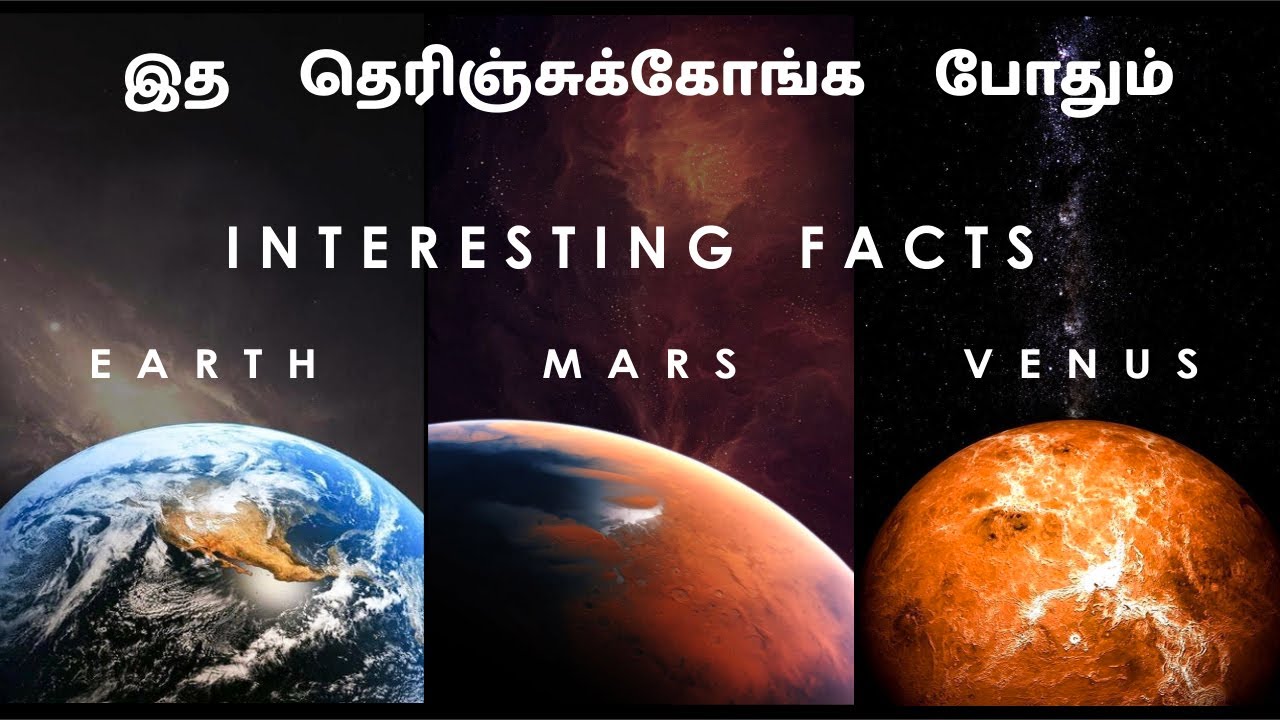
Hi everyone,
We think we know everything about our home planet, but we couldn’t be more wrong. Scientists have already discovered a lot about the Universe, but they believe there is still much more to learn about our planet. You’ll be amazed when you find out how much you have yet to learn about our home planet, let’s start with 45 unknown earth facts.
Summary:
1. There weren't always several continents
2. Some 300 million years ago, there was just one continent. A massive
supercontinent called Pangaea. And thus, there was just one giant sea,
called Panthalassa.
3. Our solar system is 4.57 billion years old.
4. Researches calculate that the earth is approximately 4.54 billion years old,
that is insanely old.
5. The earth is approximately 93 million miles (150million kilometres) from
the Sun. It makes about 8 minutes and 19 seconds for sunlight to reach our
planet.
6. Earth's gravity isn't uniform
7. Because of imbalance gravity/centrifugal force at the equator coupled with
the speed that the earth is spinning. Our planet is not a perfect sphere. it is
slightly bulging out in the middle.
9. Our poles switch. our planet has settled into a pattern of a pole reversal
about every 2,00,000 to 3,00,000 years.
10.The circumference of the globe is 24,901 miles (40,075 kilometres)
11.The earth isn't just spinning in place, its zipping around the sun at a rate of
67,000miles (107.826 kilometres) per hour.
12. Earth's icy times
13. In the past, sea levels were very different
14.The days are getting longer.
15.At the equator, you would weigh less than if standing at one of the poles.
16.Depending on where you are on the globe, you could be spinning through
the space at just over 1,000 miles per hour.
17.Hudson Bay, Canada, has lower gravity than other regions of the earth.
18.The Pacific Ocean is huge; it covers an area of about 59 million square
miles (155 million square kilometres) and containing more than the half of
the free water on earth.
21.Coral reefs support the most species per unit. Area of any of the planet's
ecosystems, rivalling rain forests.
22.Researchers believe that at one point, we had two moons. our second moon would have been about 750 miles orbited the earth in the past.
23.We always see the same side of the Moon, no matter where we stand on Earth.
24.The moon is not Earth's only companion
25.The lowest point on earth that is ' on land' is the dead sea
26.The driest place on Earth
27.El Aziziya, Libya holds the record for the hottest place on earth. According
to NASA, it hit 136 degrees Fahrenheit (57.8 degrees Celsius) on
September 13, 1922.
28.The lowest temperature ever recorded on earth came from Russia's Vostok station
29.The calm before the storm
30.A single stroke of lightning can heat the air to around 54,000 degrees
31.Our sun has a voracious appetite
32.Only 5% of the universe is visible from Earth.
33.Earth is one of the four terrestrial planets: like Mercury, Venus, and Mars. It is rocky at the surface.
34.In our solar system that are 4 planets known as gas giants: Jupiter, Saturn, Uranus & Neptune.
35. Mercury & Venus are the only 2 planets in our solar system that have no moons.
37.The hottest planet in the solar system is Venus with an average temperature
of 464 degree Celsius
38. The coldest planet in the solar system is Pluto with an average
temperature of -225 degree Celsius.
39.The Sun weighs about 330,000 times more than Earth.
41.Pluto is smaller than the United States
#top10 #facts #amazing #interestingfacts #coolfacts #amazingfacts #interestingfactsabouttheworld #solarsystem #earth #moon #sun #factsaboutspace #factsintamil #factsthatwillshockyou #brightsidevideos #factsaboutearth #factsaboutworld #factsabouttheearth #twomoons #interestingvideos #mysteriousworld #rarefacts #factsyoumustknow #shockingfacts #factsaboutsolarsystem #scientificfacts #brightside #mars #vaanveli #tamil #mysterybrightside #brightsidefacts
