#animals

1000 வருடத்திற்கு மேல் பூமியில் சூரிய ஒளி இல்லாமல் போனால் என்ன நடக்கும் தெரியுமா ? பூமியில் பெரிய எரி கல்லோ அல்லது பெரிய எரிமலையோ வெடித்தால் என்ன நடக்கும் என்பதை காட்டி உள்ளோம், அனைவரும் பார்த்து தங்களின் கருதுக்களை தெரிவிக்கலாம் நன்றி .
What If There was No Sunlight to Earth?
If there was no sunlight reaching Earth, the consequences would be catastrophic for life as we know it. Sunlight is essential for numerous biological and physical processes on our planet. Here are some of the major impacts:
Loss of Photosynthesis: Sunlight is crucial for photosynthesis, the process by which plants and some bacteria convert light energy into chemical energy to produce food. Without sunlight, photosynthetic organisms would be unable to survive, leading to the collapse of the entire food chain.
Ecosystem Disruption: The extinction of plants would result in the extinction of herbivores that rely on them for sustenance. This, in turn, would affect carnivores and other predators in the ecosystem. The disruption would likely cause a mass extinction event.
Temperature Drop: The Sun's energy is responsible for heating the Earth's surface. Without sunlight, the planet would rapidly cool down. The temperature drop would be drastic, leading to extremely cold conditions, especially in areas away from geothermal heat sources.
Loss of Atmospheric Circulation: Sunlight plays a crucial role in driving atmospheric circulation, which includes the formation of weather patterns and wind currents. Without sunlight, the atmosphere would become stagnant, resulting in the loss of weather systems and wind patterns.
Darkness: Obviously, the absence of sunlight would plunge Earth into darkness. The sky would be devoid of the typical blue color, and daylight-dependent activities would become impossible.
Disruption of the Water Cycle: Sunlight provides the energy required for the evaporation of water, which is an essential component of the water cycle. Without sunlight, the water cycle would slow down significantly, affecting rainfall patterns, freshwater availability, and overall climate stability.
Impact on Human Life: Humans, along with other organisms, depend on sunlight for vitamin D synthesis, which is crucial for bone health. The absence of sunlight would lead to widespread vitamin D deficiencies, resulting in health issues. Additionally, agriculture, which heavily relies on sunlight, would be severely affected, leading to food shortages and famine.
Regards,
VaanVeli
#volcano
#earthquake #earth #planets #extinction #clouds #பூமி #volcano #earthquake #planets #extinction #clouds #universe #galaxy #cloud #disaster #vaanveli #animals #explosion #earthattack #climatecrisis #climate #globalwarming #savetheworld #science #dangeredspecies #savetheplanet #sustainability #dinosaurs #environment #extinction #dinosaur #climatechange #wildlife #nature #extinction #supervolvano #yellowstone #asteroid #whatif #earth #whathappensif #nasa #top5 #space #universe #solarsystem #tamil #extinciondinosaurios #shorts
Hi,
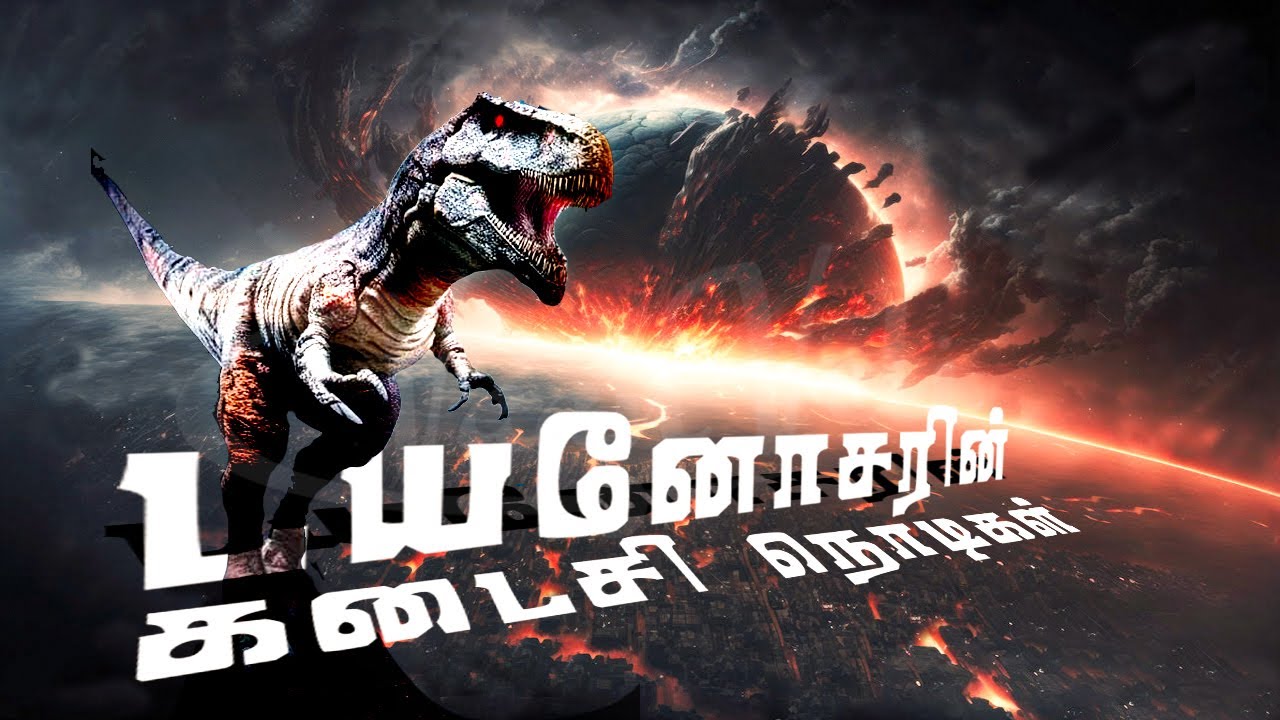
டயனோசர்களின் கடைசி நொடிகள் | Last Moment of Dinosaurs #dinosaur #vaanveli
Impact Event: The most widely accepted theory is that around 66 million years ago, a large asteroid or comet, estimated to be about 6 miles (10 kilometers) in diameter, collided with Earth. This impact event is believed to have occurred in what is now the Yucatán Peninsula in Mexico and created the Chicxulub crater. The energy released in the impact would have caused massive fires, tsunamis, and a "nuclear winter" effect, with debris and soot blocking sunlight for an extended period.
Immediate Consequences: The impact would have caused massive wildfires across the globe, releasing a tremendous amount of soot and gases into the atmosphere. This would have led to a sudden drop in temperatures, making it difficult for many species, including the dinosaurs, to survive.
Climate Change: The impact and subsequent environmental changes caused by the impact led to a drastic cooling of the Earth's climate. This would have disrupted ecosystems, causing a decline in plant life, which, in turn, would have affected herbivorous dinosaurs and the predators that relied on them.
Mass Extinction: The combination of factors, including extreme temperature fluctuations, lack of sunlight, and ecological disruption, likely resulted in a mass extinction event. Many species, including the non-avian dinosaurs, went extinct during this time.
Surviving Species: While the non-avian dinosaurs went extinct, some groups of animals, such as birds, small mammals, and reptiles, managed to survive and eventually evolve into the diverse life forms we see today. Birds are the only living descendants of the dinosaur lineage.
Regards,
Vaan Veli
Santhosh
Follows on Facebook : https://www.facebook.com/vaanveli1
Follows on Instagram : https://www.instagram.com/vaan_veli
#vaanveli #universe #solarsystem #earth #tamil #dinosaur #dinosaurs #dinasourimpact #asteroidimpact #chicxulubcrater #chicxulub #asteroid #dinosaursextinction #dinosaursintamil #dinosaurmovie #dinosaurvideo #dinosaurfootage #realdinosaur #lastmomentofdinosaurs #6thextinction #cretaceous #5massextinctions #largestcreatureintheworld #snake #crocodile #animals #birds #shark #66millionyearsago #6.6croreyearsago #dinosaurlivingperiod #humanevolution #gk

Hi, See the Top 10 Extinct Animals.
Gorgonopsia:
Gorgonopsia is an extinct clade of sabre-toothed therapsids from the Middle to Upper Permian roughly 265 to 252 million years ago. They are characterised by a long and narrow skull, as well as elongated upper and sometimes lower canine teeth and incisors which were likely used as slashing and stabbing weapons.
Dickinsonia:
Dickinsonia is a genus of extinct organism that lived during the late Ediacaran period in what is now Australia, China, Russia and Ukraine, most likely a basal animal. It is one of the best known members of the Ediacaran biota. The individual Dickinsonia typically resembles a bilaterally symmetrical ribbed oval.
Haikouichthys:
Haikouichthys is an extinct genus of craniate that lived 518 million years ago, during the Cambrian explosion of multicellular life
Astraspis :
Astraspis is an extinct genus of primitive jawless fish from the Ordovician of Central North America including the Harding Sandstone of Colorado and Bighorn Mountains of Wyoming. It is also known from Bolivia.
Pneumodesmus newmani:
Pneumodesmus newmani is a species of myriapod that lived during the late Wenlock epoch of the Silurian period around 428 million years ago.
Nothosaurus :
Nothosaurus is an extinct genus of sauropterygian reptile from the Triassic period, approximately 240–210 million years ago, with fossils being distributed from North Africa and Europe to China. It is the best known member of the nothosaur order
Scutosaurus :
Scutosaurus is an extinct genus of pareiasaur parareptiles. Its genus name refers to large plates of armor scattered across its body. It was a large anapsid reptile that, unlike most reptiles, held its legs underneath its body to support its great weight
Dimetrodon :
Dimetrodon is a genus of non-mammalian synapsid that lived during the Cisuralian age of the Early Permian period, around 295–272 million years ago. It is a member of the family Sphenacodontidae.
Jaekelopterus :
Jaekelopterus is a genus of predatory eurypterid, a group of extinct aquatic arthropods. Fossils of Jaekelopterus have been discovered in deposits of Early Devonian age, from the Pragian and Emsian stages.
Titanichthys :
Titanichthys is an extinct genus of giant, aberrant marine placoderm from shallow seas of the Late Devonian of Morocco, Eastern North America, and possibly Europe. Many of the species approached Dunkleosteus in size and build.
Regards,
Vaan Veli
Santhosh
Follows on Facebook : https://www.facebook.com/vaanveli1
Follows on Instagram : https://www.instagram.com/vaan_veli
#vaanveli #vaan_veli #universe #solarsystem #earth #tamil #animals #extinct #extinction #extinctanimals #extinctspecies #extinctspeciesofanimals #extinctioneventsonearth #5extinction #animal #monsteranimals #top10animals #top10extinctanimals #animalsintamil #extinctanimalsintamil #titanichthys #jaekelopterus #dimetrodon #scutosaurus #nothosaurus #pneumodesmusnewmani #astraspis #dickinsonia #haikouichthys #gorgonopsia #predators #lion #tiger #cheetah #snake #crocodile #fish #gk #science

https://youtu.be/nXqQKbVb9ck?si=k02e1B73VPSdpXXj
semmenarai video
நீலகிரி மலைத்தொடரில் பலரும் அறியாத ஒரு சொர்க்கம்
ooty to hireseegai kinnakorai bus travel 6am 11 15am 1 15pm
#hiddengems #travel #tamilnadu #tourist #tnstc #vlog #tourism #ooty #kinnakorai #hireseegai #coimbatore #hidden #restrictedarea #restricted #youtube #animals

Hi All,
The Chicxulub asteroid is a term commonly used to refer to the massive asteroid or comet impact that occurred approximately 66 million years ago. This impact is believed to be the primary cause of the Cretaceous-Paleogene (K-Pg) extinction event, which resulted in the extinction of about 75% of plant and animal species on Earth, including the dinosaurs.
The impact site is located near the town of Chicxulub in Mexico's Yucatan Peninsula. The asteroid or comet that struck Earth was estimated to be about 6 miles (10 kilometers) in diameter. The impact released an enormous amount of energy, equivalent to billions of atomic bombs, causing widespread devastation.
The impact triggered a chain of catastrophic events, including massive earthquakes, tsunamis, and wildfires. It also released an enormous amount of dust, soot, and vaporized rock into the atmosphere, blocking sunlight and causing a global cooling effect. The reduced sunlight led to a significant decrease in photosynthesis, disrupting the food chain and causing the extinction of many plant and animal species.
The Chicxulub impact left a distinct crater, which was discovered in the early 1990s through geological surveys and subsequent drilling. The crater measures approximately 93 miles (150 kilometers) in diameter and is buried beneath layers of sediment.
The study of the Chicxulub impact has provided valuable insights into the dynamics of large asteroid or comet impacts and their potential effects on Earth's ecosystems. It has also contributed to our understanding of the history of life on Earth and the mechanisms of mass extinctions.
The Chicxulub impactor, also known as the Chicxulub asteroid or the K-Pg asteroid, refers to a massive asteroid or comet that is believed to have struck the Earth approximately 66 million years ago. The impact of this asteroid is considered to be a significant event in Earth's history as it is widely associated with the mass extinction event that led to the demise of the dinosaurs and many other species.
Here are some key details about the Chicxulub impactor:
Size and Impact: The Chicxulub impactor is estimated to have been about 6 to 9 miles (10 to 15 kilometers) in diameter. When it struck the Earth, it unleashed an immense amount of energy, equivalent to billions of nuclear bombs.
Location: The impact site is located near the town of Chicxulub in the Yucatan Peninsula of modern-day Mexico. The region is known for a prominent crater, known as the Chicxulub crater, which was discovered in the early 1990s.
Extinction Event: The impact of the Chicxulub asteroid is widely believed to have caused or significantly contributed to the Cretaceous-Paleogene (K-Pg) mass extinction event. This event led to the extinction of approximately 75% of all species on Earth, including non-avian dinosaurs.
Environmental Effects: The impact generated a massive amount of heat, causing widespread wildfires and releasing enormous quantities of dust, ash, and gases into the atmosphere. This resulted in a global climate change event, with a significant drop in temperature and a reduction in sunlight reaching the Earth's surface. These changes severely disrupted ecosystems and led to the extinction of many plant and animal species.
Crater Formation: The impact created a crater that is approximately 93 miles (150 kilometers) in diameter and 12 miles (20 kilometers) in depth. Over time, geological processes and erosion have modified the original structure, but the remnants of the crater are still visible.
Discovery and Confirmation: The presence of a large impact crater in the Yucatan Peninsula was first proposed in the late 1970s. In the early 1990s, scientific drilling in the region provided evidence supporting the hypothesis that the Chicxulub impactor was responsible for the K-Pg mass extinction event.
Regards,
VaanVeli
#asteroid #chicxulubcrater #earth #chicxulub #chicxulubasteroid #chicxulubintamil #chicxulubasteroidintamil #vaanveli #tamil #whatif #asteroidcomparison #asteroidsize #asteroidintamil #craterintamil #dinosaur #dinosaurs #shorts #dinosaurus #dinosaurvideos #dinosaurvideojurassic #dinosaurextinction #chicxulubimpact #impact #thechicxulubimpactor #science #extinction #asteroidimpact #dinosaursintamil #chicxulubimpactsimulation #asteroidhitearth #solarsystem #asteroidbelt #gk #animals #dino
