#spaceexploration
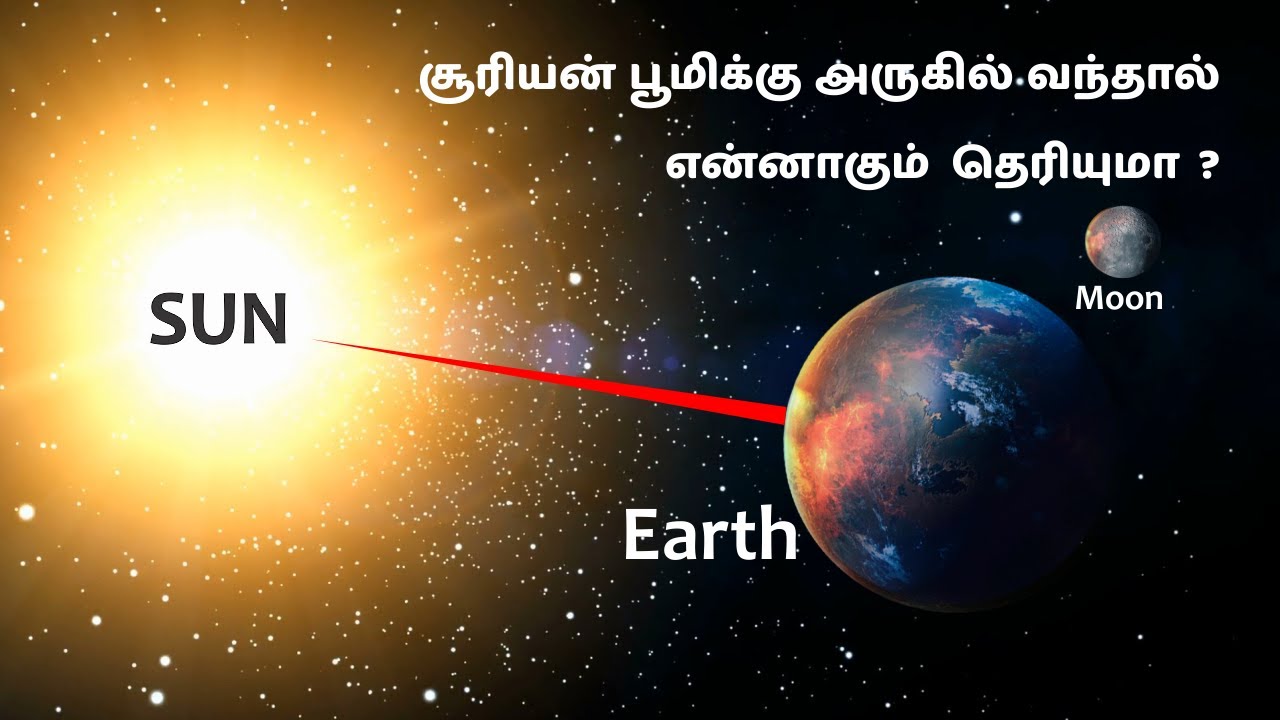
There would be enormous and maybe disastrous effects on our planet and all life on it if the Sun were to move closer to us. However, it is important to make clear that the Sun's distance from Earth is largely steady because of the balance of gravitational forces between the Sun and the planets, including Earth, before we consider the hypothetical scenario. There is almost no likelihood that such an event will occur.
Having said that, let's look at some possible effects of a closer Sun:
Temperature increases: As the Sun approaches Earth, more solar radiation will enter our globe, raising temperatures. This would cause temperatures to significantly rise, resulting in intense heat waves and a surge in the frequency of illnesses and fatalities brought on by the heat. Oceans and the surface of the Earth would warm, affecting habitats and ecosystems.
Rising Sea Levels and Melting Ice Caps: The warmer temperatures would hasten the melting of polar glaciers and ice caps, which would raise the sea level. Flooding would be a possibility in low-lying islands and coastal areas, displacing millions of people and resulting in significant ecological changes.
Global weather patterns would probably shift as a result of a closer Sun since it would probably change atmospheric circulation patterns. While some areas might experience more severe storms, others would endure protracted droughts that have an impact on agriculture and water supplies.
Many plant and animal species have evolved to survive in particular temperature ranges, which has a significant impact on biodiversity. Rapid and large temperature rises have the potential to cause widespread habitat loss and catastrophic extinctions, which would destabilise ecosystems and decrease biodiversity.
Impact on Human civilisation: A closer Sun's effects would be very detrimental to human civilisation. Food shortages, water scarcities, and energy crises would result from the climate and environmental changes, which would also pose a threat to agriculture, water resources, and energy production. To adapt to such extreme changes, significant adaptation efforts would be necessary.
Possible Orbital Changes: The Sun and Earth's gravitational fields are delicately balanced, preserving the planet's stable orbit. A large shift in this equilibrium might potentially modify Earth's orbit, creating new problems and having long-term effects on the climate and habitability of our planet.
Regards,
Vaan Veli
#solarsystem #whatif #sun #solarsystemintamil #whatifsunwasclosertoearth #whatifthesungetsclosertotheearth? #sunfacts #sunfactsintamil #whatifsunenlarge #whatifsunexpand #whatisthesunage #vaanveli #tamil #top10 #science #suntoearthdistance #sundestroyearth #thesun #space #universe #planets #astronomy #spaceexploration #whatifsuncomesclosertoearth #sunfact #thesolarsystem #sunhistory #sunvideo #earthgoingtoend #earthhistory
🌍 NISAR Satellite (NASA-ISRO Synthetic Aperture Radar) is one of the most ambitious space missions jointly developed by NASA and ISRO. This powerful satellite is designed to monitor Earth’s movements, natural disasters, and climate changes like never before.
🚀 With NISAR, scientists can study:
✅ Earthquakes & Tsunamis – Early detection and warning signs
✅ Volcano Eruptions – Monitoring surface deformations
✅ Cyclones & Floods – Tracking water levels and extreme weather
✅ Glacier Melting & Climate Change – Understanding global warming impact
✅ Forest & Land Use Changes – Keeping an eye on deforestation and urban growth
🔭 Why is NISAR so special?
It uses dual-frequency radar (L-band & S-band) to scan Earth’s surface with incredible accuracy. This makes NISAR the first radar imaging satellite of its kind, capable of providing real-time, high-resolution data for disaster management and environmental protection.
💡 In this video, we explain:
👉 What is NISAR Satellite?
👉 How does NISAR work?
👉 Why is it called the “New Eye of Earth”?
👉 How it will protect our future generations from natural disasters.
🌐 Join us as we explore the future of space science, Earth observation, and technology through the NISAR mission by NASA & ISRO.
Regards,
Vaan Veli
Santhosh
Follows on Facebook : https://www.facebook.com/vaanveli1
Follows on Instagram : https://www.instagram.com/vaan_veli
#nisar #isro #nasa #space #earth #satellite #science #vaanveli #spaceexploration #curiosity
nisar satellite,
nisar nasa isro,
nisar satellite launch,
nisar satellite explained,
what is nisar satellite,
nisar satellite tamil,
nisar satellite mission,
nisar satellite isro,
nisar satellite nasa,
nisar satellite details,
nisar satellite working,
nisar satellite uses,
nisar satellite full details,
nisar satellite news,
nisar satellite technology,
nisar satellite purpose,
nisar satellite documentary,
nisar satellite information,
nisar satellite benefits,
nisar satellite update,
Disclaimer:
All information on this channel is offered solely for educational and informational reasons only.
#k218b #superearth #earth2 | K2-18b is an exoplanet located about 124 light-years away from Earth in the constellation Leo. It's one of the many exoplanets discovered by the Kepler Space Telescope during its K2 mission.
Key Features:
Type: K2-18b is classified as a "mini-Neptune" or "sub-Neptune," which means it's larger than Earth but smaller than Neptune.
Radius and Mass: The planet has a radius about 2.6 times that of Earth and a mass about 8.6 times greater, indicating that it has a substantial atmosphere.
Host Star: The exoplanet orbits a red dwarf star (K2-18) that is smaller and cooler than our Sun. The star's lower temperature allows K2-18b to orbit closer to it while still being in the habitable zone.
Atmosphere and Potential Habitability:
Atmosphere: One of the most intriguing aspects of K2-18b is its atmosphere. Observations using the Hubble Space Telescope have detected water vapor in its atmosphere, making it one of the few exoplanets where water vapor has been confirmed.
Potential for Life: Despite the presence of water vapor, whether K2-18b can support life is still uncertain. The planet's atmosphere is likely rich in hydrogen, which is not ideal for life as we know it. Moreover, the exact surface conditions are unknown, but it's unlikely to be similar to Earth’s, given the difference in size, mass, and atmospheric composition.
Recent Developments:
In 2023, astronomers made further observations using the James Webb Space Telescope (JWST). They found additional details about the atmosphere of K2-18b, including possible indications of other molecules like methane and carbon dioxide, which could suggest some form of chemical processes happening on the planet, although this doesn't necessarily mean life exists there.
Orbit and Year Length:
K2-18b has an orbital period of about 33 days, meaning a year on K2-18b is only 33 Earth days long.
K2-18b's discovery and the subsequent studies have sparked significant interest in the scientific community, especially regarding the search for habitable worlds beyond our solar system.
#k218b #exoplanet #astronomy #spaceexploration #ExoplanetDiscovery
#astrobiology #jameswebbtelescope #HubbleSpaceTelescope
#minineptune #reddwarfstar #watervapor #alienworlds #HabitableZone
#spacescience #cosmos #superearth #planetaryscience #earthlikeplanet #earth2 #earth2point0 #newearth #secondearth #space #universe #cosmos #galaxies #outerspace #interstellar #cosmic #spacetime #theuniverse #kepler #kepler452b
K2-18b Super Earth, K2-18b Exoplanet Discovery, K2-18b Atmosphere Analysis, K2-18b Water Vapor Detection, K2-18b James Webb Telescope, K2-18b Habitable Zone, Life on K2-18b, K2-18b vs Earth, K2-18b Super Earth Explained, K2-18b Alien World, K2-18b Latest Discoveries, K2-18b and Red Dwarf Star, K2-18b Mini Neptune, Exploring K2-18b, K2-18b Astronomy News, K2-18b Super Earth in Tamil, James Webb Telescope in Tamil, Habitable Zone in Tamil, Life on K2-18b in Tamil, K2-18b vs Earth in Tamil, K2-18b Super Earth Explained in Tamil, Astronomy News in Tamil, #superearthintamil #vaanveli பூமியை போன்ற மற்றொரு கோள்
Regards,
Vaan Veli
Santhosh
Follows on Facebook : https://www.facebook.com/vaanveli1
Follows on Instagram : https://www.instagram.com/vaan_veli
Disclaimer:
This channel does not offer financial advice. All information on this channel is offered solely for educational and informational reasons.