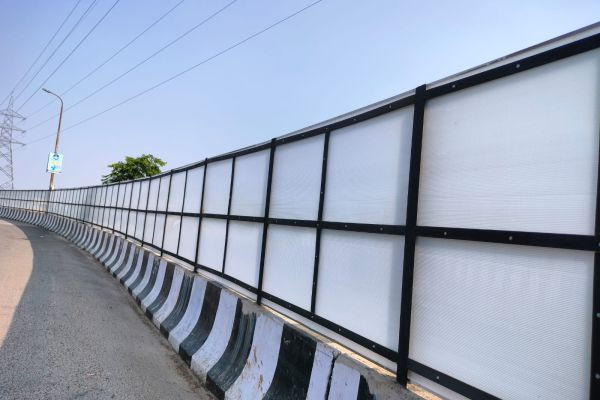
The noise that is generated by highways, railway lines, and other busy roads has become a big problem in places where these transport systems are located close to residential and office buildings and other public places. The noise pollution created by traffic makes it difficult for people to achieve peace. The transparent noise barrier becomes a good choice that stops the transfer of noise and maintains visibility. Unlike the usual opaque walls, these barriers transmit light and hence make it easier to keep the roads and other construction sites visible. Transparent noise barrier manufacturers, like Greenvent, help in noise control projects.
Why Is Noise Pollution a Growing Concern in Urban and Industrial Areas
As cities grow and traffic increases, noise pollution caused by traffic, trains, machines, and construction becomes an issue. Noise pollution leads to disruptions in communication and makes it difficult for people to concentrate. It is very irritating for those who live near highways. Moreover, it is essential to install noise barriers at industrial places so that noise from operations is limited in neighboring zones. Traditional noise barriers work well to stop noise, but their rigid structure can make an area look closed. Transparent barriers solve this problem, combining acoustic and visual features. Selecting transparent noise barrier manufacturers allows managing both noise pollution and the look of infrastructure areas.
How Do Manufacturers Reduce Traffic Noise
Transparent noise barrier manufacturers produce barrier systems that block any direct route for traffic noise that travels towards nearby buildings. On impact with sound waves, the barrier reflects some of the sound waves back, while the rest of the sound waves get absorbed or get transferred by the barrier. An area with less noise is created beyond the barrier due to the acoustic shadow formed by the barrier. However, the exact level of noise reduction depends on several aspects, including the height and length of the barrier. The manufacturer provides noise barrier systems for any infrastructure needs where sound management and visibility play a role.
What Materials Are Used to Manufacture Transparent Noise Barriers
Transparent noise barrier manufacturers keep in mind all these factors while creating a solution for roads, railroads, bridges, and construction sites in cities.
- Acrylic Panels: They have very good optical clarity and a good aesthetic appearance at locations where visibility is important.
- Polycarbonate Panels: These panels have the property of resistance and are selected for places where strength matters.
- Treatments: Based on the type of material to help with weather resistance and other environmental conditions.
- Mounting Systems: To anchor the barrier to its supporting structure, keeping it aligned through its entire life cycle.
The right combination of materials will depend on the design and environmental conditions of the project.
How Do Transparent Noise Barriers Maintain Visibility While Reducing Noise
The notable benefit of transparent barriers is that of providing noise suppression while still being able to keep the view intact. Transparent panels are used on the roadside, on bridges, and even on above-ground transportation systems, allowing people who pass by to see and be linked to their surroundings. Additionally, light can penetrate easily through the transparent panels, and this makes one feel that one is not in a confined space while using conventional barriers. All these considerations rely on the barrier's thickness, density, size, and quality of installation. Noise barrier solution manufacturers provide noise barrier solutions where both acoustics and visuals are considered.
Where Are Transparent Noise Barriers Commonly Installed
Transparent noise barriers are used for any infrastructure works that require noise control but cannot have an entirely opaque barrier installed. The appropriateness of transparent noise barriers depends on the type of noise generator, site layout, structures involved, and level of noise attenuation desired.
- Highways: Can be used to reduce traffic noise affecting residential or other neighboring developments.
- Railway Tracks: Can serve as a noise barrier between railway operations and other properties.
- Flyovers: Can offer various choices for noise barriers, taking into account space and visual conditions.
- Commercial Areas: Can support noise barrier design for structures located close to transport facilities.
Depending on the specifics of each site, different acoustic and structural characteristics of the barriers should be considered.
What Are the Main Benefits of Transparent Noise Barriers for Highways
Noise is continuously produced by the engines, tires, horns, and heavy trucks on highways. The use of proper noise control measures will assist in minimizing the effects of such roads when they are located near residential areas, hospitals, offices, and other sensitive places. Transparent barriers can be used as an alternative to solid walls in cases where there is a need to maintain the visibility of the surroundings. The effectiveness of transparent barriers depends on their design, materials, and installation rather than transparency.
How Do Manufacturers Ensure Durability and Performance
An effective sound barrier is one that can stand up to the installation environment as well as maintain the acoustic requirements. The highway and railway environments place wind loading, dust, rainfall, temperature variations, and vibrations on the panels and support frame. Transparent noise barrier manufacturers take all these conditions into account during their selection of materials, design of panels and frames, and also the method of installation. Efficient frame design prevents panels from coming off, while appropriate joints and seals minimize gaps that might let sound through. Greenvent helps locate any loose fixtures, damage to panels, deterioration of surfaces, and other performance problems.
How Does Greenvent Support Noise Control with Transparent Noise Barrier Solutions
Choosing a noise barrier is not only about picking a clear panel. The team working on the project needs to take into consideration the noise source, building surroundings, installation area, structure support, and the desired acoustic result. Transparent noise barrier manufacturers like Greenvent provide solutions for projects that need sound control while maintaining visibility. In assessing transparent noise barriers, planners can address issues such as the use of the product, the panel material, the size of the barrier, structural needs, and environmental exposure.
Lastly, transparent noise barriers can be used to control noise pollution from highways, railways, and urban traffic without compromising visibility and letting light through. For this, appropriate materials, the right size, stability, and installation are required. Acrylic and polycarbonate panels can be considered for such projects that require transparency and strength. Transparent noise barrier manufacturers can be useful in developing effective solutions for such problems. Greenvent can be considered while selecting transparent noise barriers for any project.
FAQs
- What are transparent noise barriers?
Transparent noise barriers are acoustic barriers made from see-through materials that help reduce noise while maintaining visibility. - Where are transparent noise barriers used?
They are commonly used along highways, railways, metro corridors, bridges, and urban infrastructure projects. - What are the benefits of transparent noise barriers?
They help manage environmental noise while allowing natural light and maintaining visual openness in the surrounding area. - Which materials are used for transparent noise barriers?
Materials such as acrylic and other suitable transparent panels are used, depending on the project's acoustic, structural, and environmental requirements.